

At long last, a continuation in my children's book series. To recap: this series is divided into five parts consisting of 6 posts.
Part One talked about strategies for using your local library to find quality children's books.
Part Two (A) discussed several design fundamentals that contribute to superb illustration in picture books.
Part Two (B) (this post) will talk about several more design fundamentals that contribute to superb illustration in picture books.
Part Three will explore language and literary techniques used in quality writing for children.
Part Four will provide a genre summary and list recommended titles in each genre.
Part Five will list 100 excellent author/illustrators for children with either links or a brief overview of their works/style.
A repeat of my copyright caveat: I use a lot of pictures in this post most of which are copyright protected. I did not scan any images into my computer nor upload them. I am simply drawing in images from elsewhere on the web. My purpose in doing so is solely to promote the books depicted. I have not used images from books I do not recommend. I also do not derive any income (monetary or goods and services from my writing); as such I am in no way profiting from the intellectual property of others. Having said all of that, I will remove all embedded images except for book covers from this post and replace them with external links in 7 days time. In the interim, should I receive any requests from copyright holders to remove images from this post, I will do so immediately.
And now, to pick up where we left off...
You may recall that I am relying on The On-line Visual Literacy Project at Ponoma College for my terms of reference in defining the 11 basic design components of all visual communication. I have grouped these components into 4 broad categories.
The building blocks (dot, line, shape, and texture) (the subject of my last post in this series)
Movement (motion and direction)
Colour (hue, value, and saturation), and
Perspective (scale and dimension)
The rest of today's post will look at movement, colour, and perspective.
From utter stillness, motion emerges: Image Link (note: I've added the external links to the images just in case you want to see a larger version of any of them.)
Rob Gonsalves holds stillness and motion in tandem in this surreal illustration featured in Imagine a Night (2003). His paintings have been pulled together in three separate picture books, Imagine a Night, Imagine a Day, and Imagine a Place, all with text provided by Sarah L. Thomson. The text doesn't shine so well as the illustrations but the books are stunning eye candy for all ages.
Picture book artists create motion on a fixed, 2-dimensional plane by using using multiple techniques, and, unlike the Gonsalves illustration would you have you believe, the motion created is, most often, pure silly fun. Image Link
David Shannon's title character from No David! (1998) makes a mad dash from his bath. The oversized sidewalk seems to spit him out, limbs extended and body soaring skyward. Image Link
Barry Moser's rabbit leaps above the title of this book: Jump!: The Adventures of Brer Rabbit by Joel Chandler Harris, Van Dyke Parks, Malcolm Jones (1986). The torn blue backdrop that is slightly akimbo reinforces the motion suggested by the image. Image Link
Moser again on the cover of Margie Palanti's Earthquack! (2002). Even the letters in the title are subject to seismic upheaval.
Image Link
Lane Smith's retro, space-age tumble into the abyss on the cover of Scieszka's Math Curse (1995).
And now, a few motion-centric illustrations that bring me joy: Candace Fleming's Smile Lily, 2004 Image Link
 Helen Cooper's continuation of the Pumpkin Soup story, Delicious, 2007.
 Me and My Sister, Ruth Ohi, 2005.
 Linda Bailey's Stanley's Party illustrated by Bill Slavin, 2003.
One of my favourite object lessons in motion could not be found on the web but I'm sure most of you will be able to picture the image immediately if I simply type the words, "LET ME DRIVE THE BUS!!!!!!"
While motion suggests movement on the page, direction prompts the movement of your eye over the page. Image Link
In this illustration from Barbara Reid's Sing a Song of Mother Goose (1987), Jack and Jill are pure motion; their tumble down the hill, though, directs the reader's eye straight to the page turn, for one does not linger in the verbally tripping land of the nursery rhyme. Image Link
Harold's policeman also points to the page turn with his arm and his eyes. (Harold and the Purple Crayon by Crockett Johnson, 1955) In the illustration from No David! above, the sidewalk forces our eyes to follow David's streak to freedom.
Image Link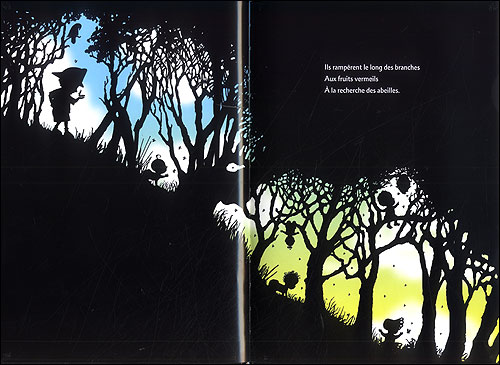
Image Link
Peggy Rathmann's heroic quest, The Day the Babies Crawled Away (2003), features a driving, rhyming cadence that is accompanied by illustrations that move the reader's eye from top corner left to bottom corner right. As such, the story tumbles along until the pattern stops abruptly when our hero and his infant charges get trapped at the bottom of a cliff. At this point in the story, the black frame of the page surrounds them on three sides, effectively holding them captive. Sadly, I could not find an image online to show the trapped scene, but I think you can imagine what I mean. Image Link
Anthony Browne's Willy is a nose-in-the book sort of fellow. No so, his friend Hugh, who attracts the annoyed stares of the other library patrons. The entire meaning of this illustration from Willy and Hugh (1991) is told by following the direction of the eyes. You may need to follow the image link to get the full effect of this one. And finally, here's one more marriage of motion (the font, the girl with arms uplifted) and direction (the buildings) acting in harmony. Robert Neubecker's Wow! City! (2004)
Colour has become a dominant design principle in illustrated books for children over the last several decades. Classics, such as Johnson's Harold books and McCloskey's Make Way For Ducklings or Blueberries for Sal, however, are evidence that illustration can be divine on a monochromatic scale.
From Blueberries for Sal (1948) Image Link
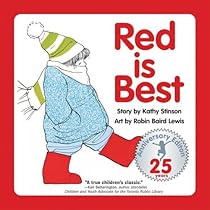
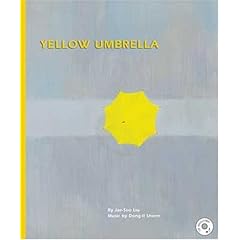
Other books, such as Richard McGuire's Orange Book (1992), which uses only the complementary colours of orange and blue, or Cathy Stinson's Red is Best (1982), which emphasizes the narrator's preferred colour, or the wordless picture book Yellow Umbrella (2001) by Jae Soo Liu deal in the essence of hue.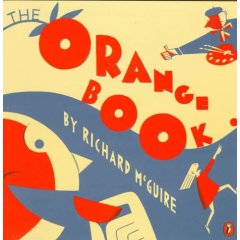
Hue is plucked straight from the colour wheel and comes in the infinite combinations of those three primary colours: red, blue and yellow. Bob Staake's The Red Lemon (2006)
 from Fish Eyes: A Book You Can Count On by Lois Ehlert (1990) Image Link
A picture can comprise mainly warm hues: a cross-section of the old white cabin in Delicious by Helen Cooper (2007) Image Link
Or cool hues: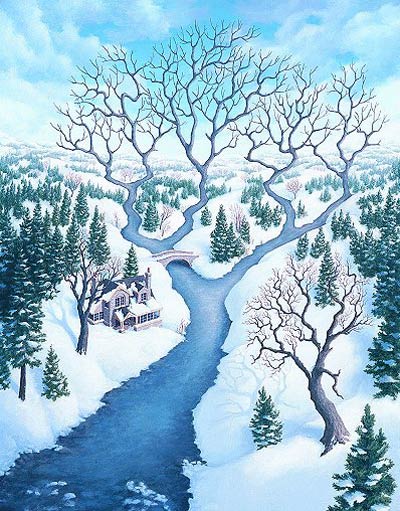 From Rob Gonsalves' Imagine a Place (2008) Image Link
Sometimes the lifeblood of the image is a pocket of warm colour lying in a sea or sky of cool: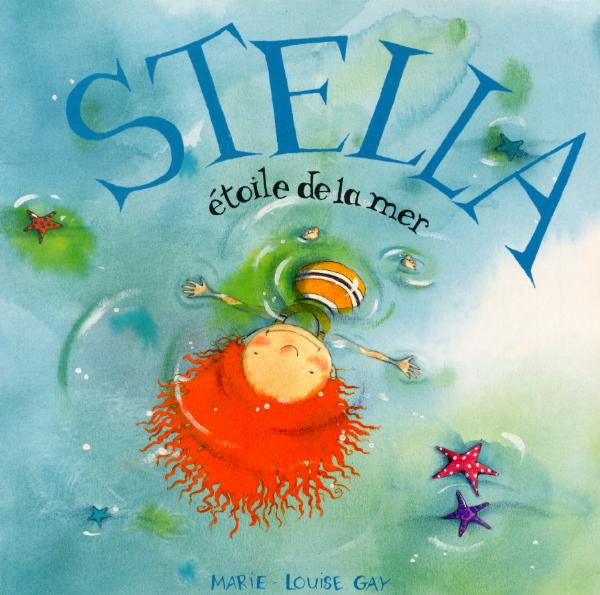 Marie-Louise Gay's Stella: Star of the Sea (English language version) (1999)
 Christopher Myers' Wings (2000)
Value refers to the amount of light or dark in an image and the interplay between them.
From Peggy Rathmann's The Day the Babies Crawled Away (2003) Image Link From Creation by Gerald McDermott (2003) Image Link
Whereas Beatrix Potter uses value to show the warmth of the hearth in winter,
Chris Van Allsburg plays with value to eerie effect in The Mysteries of Harris Burdick (1984), a suggestive, imaginative picture book for elementary aged children. Image Link
 Image Link
Ed Young's mice sparkle against their black backdrop in Seven Blind Mice (1992), and Image Link
Ted Harrison's depiction of the Aurora Borealis feels like stained glass, so filled with light are his colours. From O Canada (1992).
Saturation deals with the amount of grey that influences a colour. Image Link
In Janell Canon's Stellaluna (1993), the contrast of the bats who lack colour saturation with the highly saturated night sky provide maximum visual impact. The resulting ultra-realism emphasizes the vulnerability of the bats, creatures that the reader may not normally sympathize with. Image Link
In Knuffle Bunny (2004), Mo Willems splashes highlights of mid-saturated colours over top of black and white photo stills of a Brooklyn neighborhood to add a family atmosphere to the city backdrop. His illustrations often look like animation stills.
The use of water colours produces a canvas of lightly saturated colours. Image Link
In many books, and Barbara McClintock's Dahlia (2002) is a fine example here, such illustrations have a rural or old-fashioned feel to them, no doubt because they hearken back to the 19th and early 20th styles of early masters in the genre: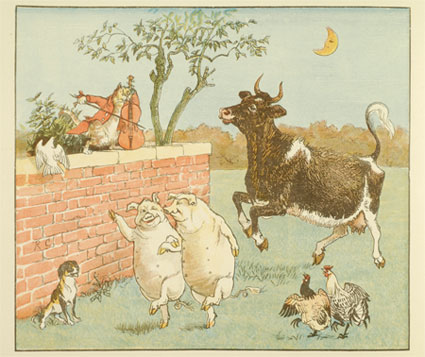
Randolph Caldecott Image Link
Kate Greenaway Image Link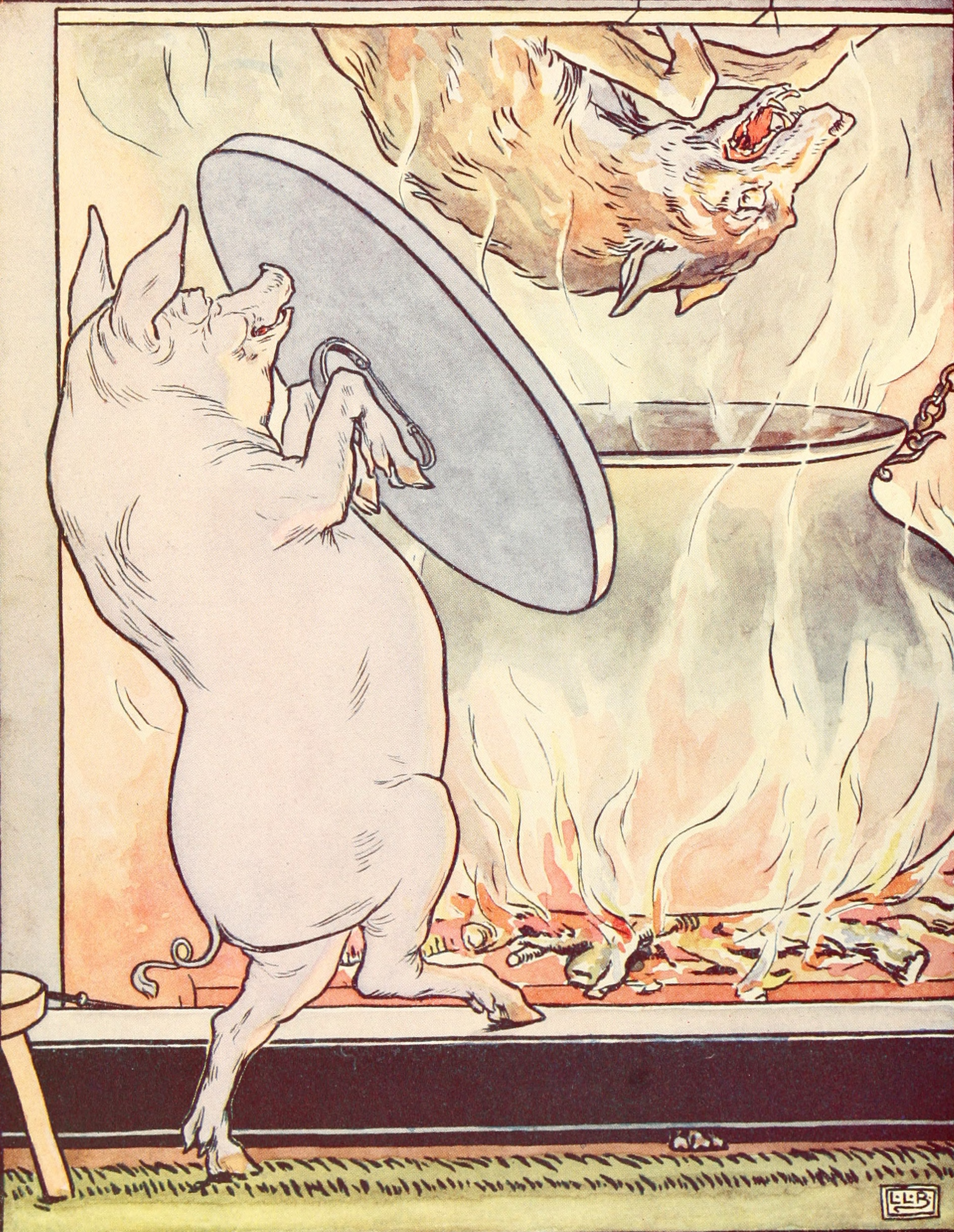
Leslie Brooke Image Link
and Beatrix Potter Image Link
And then there is Norton Juster's Hello, Goodbye Window, illustrated by Chris Raschka, that conjures up a rustic nostalgia by using mid-saturated, high value colours.
 Image Link
If you want to see what Rashka has to say about his approach to illustrating this book, read the engaging caption he put on one of his pictures that was reproduced for the New York Times.
Raschka uses a similar style for a cover of the Horn Book Magazine. Deelish.
Highly saturated colours often, but not always, suggest an urban or contemporary setting, partly because contemporary printing technology allows for the mass reproduction of rich colours.Here is Raschka again with Yo! Yes? (1993)
 Vera B. Williams' A Chair for My Mother (1982). Image Link
Then there's the tropical feel of Dayal Kaur Khalsa' My Family Vacation (1988):
Highly saturated colours also feature prominently in many folk tales. Different colour combinations can be suggestive of different cultures or ethnicities: Leo and Diane Dillon's Why Mosquitoes Buzz in People's Ears: A West African Tale (1975)
 Ricardo Keens-Douglas' The Nutmeg Princess; illustrated by Annouchka Galouchko (1992) (a folk tale from Grenada)
 Gerald McDermott's Raven: A Trickster Tale From the Pacific Northwest (1993).
Phew. Colour dang near killed me. I hope you're still with me. We're coming down the home stretch.
Last but not least, we come to perspective and the two visual techniques that help to determine it: dimension and scale.
Dimension refers to the level at which a reader's eye encounters an image. Are we viewing the scene from on high? Are we looking up from the ground? Or are we meeting the image at eye level?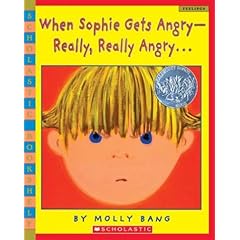 Molly Bang's When Sophie Gets Angry--Really, Really Angry (1999), shows the child reader what a temper tantrum looks like from a child's eye view.
 Image Link
When Sophie explodes, the dimension is eye level. When Sophie runs away and feels very small, the reader sees her as a speck on the landscape. By carefully manipulating dimension, the artist aligns the reader's sympathies with her character. Throughout the book we identify with Sophie and can therefore better empathize with her situation.
Now you tell me, in this illustration from David Wiesner's Tuesday (1991) are we meant to identify with the people who inhabit the town or the town's mysterious night time visitors? Image Link
Scale is similar to dimension but it is intrinsic to the picture itself rather than relying on the reader as viewer. Scale can simply let us know the size of one object relative to another as is the case in this picture from Wiesner's June 29, 1999: Image Link
And scale can sometimes make you smile: From David Shannon's Duck on a Bike (2002) Image Link
Alternatively, scale can convey the emotional crux of a situation. Take for example the day Willy the Wimp accidentally bumps into Hugh: From Anthony Browne's Willy and Hugh (1991)Image Link
______________________________________
In regaling you with examples of how the 11 design principles work in picture books, it was my hope that you would see how smart illustrations, when combined with visual literacy skills on the part of the reader, can contribute to the overall experience of reading a book. Do I kid myself that my daughter sees all this when she is looking at books?
No. Not for a second. But she does see a lot of things in illustrations that I don't catch right off. We also spend a lot of time talking about the pictures in her books in an effort to tease out both our ways of seeing. Books that are flatly illustrated don't allow us to open up the conversation. They don't influence our mood or emotions as we are reading. The really good books do, though, and each time I come back to those books to figure out why, the answer is usually right there in front of me in their finely crafted illustrations.
________________________________
OK, you all need a break from this so I won't post again in this series for at least a week if not longer. Truth be told, I need a bit of a break too. This was some hard work finding all those pictures and then making them fit my big picture. Next up, I'll be savouring the flavour of words. Mmmmmm, tasty words.
Monday, November 17, 2008
How to know when a book is superb: pictures edition, part 2

Tuesday, November 04, 2008
How to know when a book is superb: pictures edition, part 1
This post is the second in a series about identifying and selecting quality children's books for the preschool set. Part 1 is here. Parts 2b, 3, 4, and 5 will follow in the next couple of weeks ... or longer. These posts are likely going to be long-winded so I want to give my readers lots of time off in-between.
Copyright caveat: I use a lot of pictures in this post most of which are copyright protected. I did not scan any images into my computer nor upload them. I am simply drawing in images from elsewhere on the web. My purpose in doing so is solely to promote the books depicted. I have not used images from books I do not recommend. I also do not derive any income (monetary or goods and services from my writing); as such I am in no way profiting from the intellectual property of others. Having said all of that, I will remove all embedded images except for book covers from this post and replace them with external links in 7 days time. In the interim, should I receive any requests from copyright holders to remove images from this post, I will do so immediately.
On with the show...
What is the role of pictures in books for young children? Is it simply to illustrate the text? Having spent so many years as readers, we adults tend to privilege text at the expense of illustration. Library users are always asking me for a good story, a funny story, for a tale about trucks, ballerinas, or animals, for a book that teaches manners or what have you, for a book that will help a child learn to read, or one that fosters a desired "learning outcome" (now there's an expression that makes me want to puke). I only rarely have users come to me looking for a certain style of art or expressing a desire to teach visual literacy.
I remember reading simple vocabulary books to Miss M in that year where language hit her like a tidal wave. Words. Words. Words. Words were what she needed and words were what I gave her. Invariably, I found my word-centred self pointing to the black squiggle of text as I was reading and not to the picture she was looking at. Young children see the world differently, though. They acquire visual literacy long before they can decipher those black marks on the page. Good children's writers and illustrators know this. Good children's writers and illustrators design their books to cater to a child's need for aural, verbal, visual and, eventually, written literacy.
The most common form of book for young children is the picture book: 32 pages that most often contain text and pictures, although the former can be absent. In a good picture book, the text and art complement each other. I use the word "complement" on purpose, as it comes from the root "complete." In a good picture book neither the text nor art is complete without the other. Oftentimes the story can stand alone in a less rich form, but many innovative picture books depend on their illustrations to tell part or all of the story.
Take for example, Pat Hutchin's Rosie's Walk published in 1967. It is usually acknowledged as the first picture book in which the words deliberately leave out part of the story. The words tell in brief, literal detail what happens when Rosie, the hen, goes for a walk around the barnyard. Only the illustrations show what happens to the ill-fated fox who chooses to follow her. Page after page, the fox gets his comeuppance and Rosie? Well, she gets "back in time for dinner". End of story.
IMAGE LINK
This style of integrated storytelling is quite prevalent in contemporary picture books. One of my favourite renderings of it is the Caldecott medal-winning Officer Buckle and Gloria by Peggy Rathmann.
I wish I could find pictures online to show you Gloria the police dog's outlandish enactments of Officer Buckle's safety tips. Better yet, I wish I could show you the climax illustration when Officer Buckle realizes he's been had by his best friend. You'll have to go check it out to see for yourself if you haven't read it already.
How does the 10 dollar expression "visual literacy" differ from the 10 cent version "looking at pictures"? A lot can be said for how pictures themselves invite the reader in and promote an interpretive framework. A few basic design principles provide the foundation for all visual communication. How these principles are employed by the artist acting in tandem with the writer determine the degree of engagement a reader can have with a picture book. To explain, I am relying on the The On-line Visual Literacy Project at Ponoma College. The article, which outlines the 11 fundamental components of design, is well-researched and well-cited. I highly recommend it, should you wish to pursue these issues further (and, perhaps, catch all my errors in interpretation). I plan to tackle the basic design components here by dividing them into four groupings and looking at those groupings through the lens of picture book illustration. They are:
The building blocks (dot, line, shape, and texture)
Movement (motion and direction)
Colour (hue, value, and saturation), and
Perspective (scale and dimension)
The rest of today's post will look at the building blocks. My next post will cover movement, colour and perspective.
The Building Blocks
The dot and the line are fundamental to all artistic creation. The dot is a stable, grounding force: a moon in the sky or an object in the distance that your eye is drawn to. Lines create while dots merely are. The exception to this rule is in contemporary visual technology whereby all images are expressed through a series of dots. The genius of Roy Lichtenstein was to turn our way of looking at a screen or a comic book back on us and to make us aware of the visual make-up of new technology as a series of dots.
IMAGE LINK
The line creates all movement, direction, and perspective. The line, when used cleverly, is an object lesson in how art works.
IMAGE LINK
IMAGE LINK
Straight lines, particularly diagonals suggest activity. Curved lines sooth and rock with a gentle motion.
From lines, shape emerges. The comforting, rolling circle is a big ol' dot that depends upon line for its movement.Richard McGuire's Orange Book, 1993
IMAGE LINK
Kevin Henkes' Caldecott-winning Kitten's First Full Moon, 2004. Notice the grounding circles in the moon, in the fireflies and in the kitten herself. Then notice how the angled line of the tail directs your eye to the moon so that we look at they very thing that has caught the kitten's attention.
The claustrophobic square and rectangle...
IMAGE LINK
...with their promise of escape.
IMAGE LINK
Is it any wonder that Sendak's masterpiece, Where the Wild Things Are, begins in Max's house bounded by a white, square frame on the page. With each page, the frame gets smaller and smaller until Max sails off to the land of the wild things. At this point, the frame disappears altogether and the image becomes a full-page bleed. In fact, the wild things themselves would burst the bounds of the book if they could.
IMAGE LINK
The manic triangle is all lines and angles scarcely bound. It keeps your eyes always moving.
IMAGE LINK
IMAGE LINK
Triangles, because they contain at least two diagonal lines, represent energy and movement, particularly when they are sitting on their angles instead of their base.
An aside:
If your child has moved past the random scribble in fine motor skill development (mine has not), check out the books of Ed Emberly. Alternatively, go to his website where you will find countless drawing exercises that let kids turn the dot, the line, and the fundamental shapes into just about any object under the sun. Voila: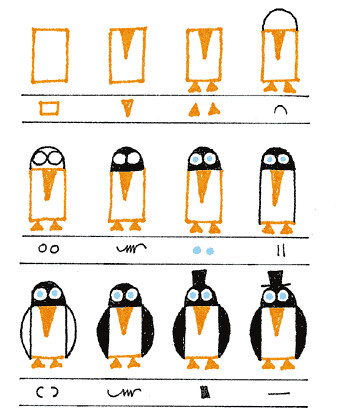
Child readers discover texture early on: pat the bunny, pop-up, and crinkle-paper books abound in our tactile, catered-to-baby culture. An image does not need faux fur or sandpaper to convey texture, though, and different illustration techniques can often make a one-dimensional image seem 3D.
IMAGE LINK
Canadian Barbara Reid models her illustrations out of clay before they are transferred to paper for printing. This illustration is from Effie, 1999. The computer screen does not do justice to the level of detail in her art. Take, for example, this image from her version of Noah's ark entitled Two By Two, 1992.
IMAGE LINK
If you haven't read a book with Barbara Reid illustrations, hurry out and do so immediately. As an aside, there is a wonderful detail in this illustration: Noah's wife (dressed in green on the middle deck) has just realized that she's stepped in dung and is looking at the bottom of her shoe in disgust.
Wallace Edwards supplements detail with competing colours and patterns to create a textured look.  from Wallace Edwards' Alphabeasts, 2002.
Eric Carle creates texture by using multi-coloured tissue paper in his art. It's always fun to read a bunch of Carle books and then have your kids create tissue paper art. You can give them colouring page image outlines, if you want, and then let them do the rest.
IMAGE LINK
Barry Moser, Chris VanAllsburg, and Christopher Bing have all used woodcuts or pen-and-ink in the style of woodcuts to create texture.
IMAGE LINK
______________________________
OK, out of 11 design fundamentals, I have now covered 4 and the post is waaaay long. Stay tuned for part b in a few days. In the meantime, ask yourself as you read stories to your kids, "does this picture add something of value to the book? Does it create mood, set tone, establish character? Is the image energetic or peaceful? Does it extend the mind in interesting ways beyond what is conveyed by the words on the page? How does it accomplish its task?"
Now here's a question for all of you: What picture book or illustrator's style do you like in particular and why? Don't be shy to answer. I love nothing more than learning about what makes children's books work. All other comments or discussion points are welcome as well.
Tuesday, October 28, 2008
Mad's whacky blog of books. It's all books, all the time!
Moma left this comment on a recent post:
One thing I was wondering about was how to evaluate kid's books and was hoping you might write a post on that. For example, my daughter loves the Arthur and Franklin series. Would these be considered good reading? What should I be looking for in a book for a preschooler? It was easier to pick out books when they only had a few words on the page.
I always find it hard to blog about this kind of thing because we all have to stumble our way through libraries and bookstores as parents and we all develop tips and tricks in the process. I never like to presume that I have better ways of doing things than the next parent. Having said that, selecting children's books is what I do for a living and I do think I have developed professional savvy over the years. I regularly give library instruction sessions to education students who will need to select and evaluate books for children in their careers. About a week ago, I gave a workshop on picture book literacy for a large group of day care and preschool teachers. So, for those who might be interested, here is my 2 cents dollars worth.
I will make my answer a series of posts that will come out over the next couple of weeks or so with the odd interruption for Hallowe'en post-mortems and other daily life occurrences that demand bloggy treatment. The series will run as follows:
Part 1 (today's post): Tips for finding good books and making the most of your local library.
Part 2: How to know when a book is superb: pictures edition
Part 3: How to know when a book is superb: words edition
Part 4: Genre summary with a few title recommendations
Part 5: A list of 100 excellent author and/or illustrators for the pre-school set
Part 1: Tips for finding good books and making the most of your local library
1. Ask your children's librarian for recommendations: A good children's librarian is yours and your child's best friend. She/he will be able to recommend books that are pitched to your child's interests and abilities. She/he will know other books that are like titles your child already loves. She/he will know if a new dinosaur book has just come in or if the latest Stella and Sam book is about to be published. If Christmas is coming, ask him/her about what books to buy vs borrow for your child or other children. Ask her what tools and resources are available at the library to help you self-select materials. Shop around for a librarian or library staff person that you mesh with. Just because you had a bad experience with one person at the help desk doesn't mean that another person in the organization won't be more up your alley.
I know that this recommendation doesn't particularly help people who rely on small or rural libraries as much as it does to people in larger centres but, hey, that's why I have several recommendations on this list.
2. Use your library catalogue: Find out how to use your library catalogue well and then use it often. In my library, I can limit search results to just children's books (and sometimes depending on the search I can limit to just the picture books in the collection). Setting such limits makes it easy to perform targeted searches on subjects my daughter is currently interested in: elephants, dinosaurs, farms and the like. Library catalogues may also allow you to limit your searches by date of publication or language as well. For example, I get countless language students coming to me looking for French children's books to help them as they learn the language.
3. Read reviews: Does your local paper write reviews of children's books? If so, read them and then ask for recommended titles at your library. Does your library subscribe to a reviewing service like the Children's Literature Comprehensive Database (CLCD)? If so, you can quickly and easily look up reviews of books that you might be considering for your child to find out if a) they are recommended and b) if they would be appropriate for your particular child. If your library does subscribe to the CLCD, you can generate subject specific book lists that are pitched to a particular age range or reading level.
4. Devour award winners: Read your way through the extensive lists of award winners and honour books that are now posted all over the internet. If you find a book you especially like, then find every other book that author wrote. Keep in mind that award books can span age ranges so make sure you've got an age-appropriate book in your hands before you start reading aloud at bed time. Here are some lists of award winners to get you started but there are plenty more out there:
US-based awards
The Caldecott Medal: Awarded to the best picture book by an American citizen or resident published in the US in any given year. The current winner and honour books are listed here. A complete listing of past winners is here.
The Newbery Medal: The oldest, ongoing prize for children's literature in the world, the Newbery medal is awarded to the most distinguished work for children published in the US in any given year. The current winner and honour books are here. Past winners are listed here.
The Michael L. Printz Award: An annual award that recognizes literary excellence in young adult literature. The current winner and honour book are listed here. The full listing of past winners and honour books is here.
The Coretta Scott King Book Award: This annual award is given to African-American writers and illustrators of books for children. The current winner is listed here (and is sitting by my bedside) along with the 2008 honour books. A full listing of winners and honour books can be found here.
The Boston-Globe Horn Book Prize is presented annually in three categories for prestigious picture book, fiction and poetry, and nonfiction published in the United States. Here's the current winners and the full listing of award winners.
The New York Times Best Illustrated Books for Children is an annual listing. Here is a slideshow for the 2007 edition of the awards.
Canadian Awards
The Governor General's Literary Awards: Awarded annually, one for children's text and one for children's illustration with categories in both English and French. Here's the 2008 shortlist. Here is the list of past winners.
The Amelia Frances Howard-Gibbon Award: Awarded to the outstanding illustrator of a children's book published in Canada. The complete list of winners is here.
The Canadian Children's Book Centre maintains a listing of Canadian book awards. Rather than reprinting it all here, you can find the full list on their website.
British Awards
The Kate Greenaway Medal: Awarded annually for children's illustration. It's the UK's equivalent to the Caldecott Medal. Current short list is here. Past winners are here.
The Carnegie Medal: Awarded annually to the writer of an outstanding book for children. It's the British equivalent of the Newbery Medal. Current short list is here. Past winners are here.
Smarties Prize (renamed Nestle Book Prize): A recently discontinued UK prize for various age categories of children's literature. The Smarites Prize was sometimes considered controversial because of its affiliation with Nestle and their practice of promoting infant formula use in developing countries. 2007 winners are on the main page. Past winners are listed here.
International Distinction
The IBBY Honor List: a bienneal listing of excellent books for children put out by the International Board on Books for Young People.
5. Seek out lists, blogs and children's book web sites: In this bloggy age, a lot of informed people are posting book lists, reviews and recommendations. I keep lists of all the books Miss M has read over on my sidebar there. Librarian-mother-blogger extraordinaire, Kittenpie, has a couple of review sites: one for younger kids and one for older ones. That second link also has links to some other children's review sites. Mo-Wo and P-Man also recommend books every now and then. Just One More Book features daily podcasts on children's books. The list goes on and on, but my hope is not to overwhelm you in this post.
6. Make sure you cover off as many genres as you can. There are so many kids today who never hear poetry or who don't receive grounding in oral folk-tale culture. That grieves me. In Dewey classification systems, the picture books and easy readers are catalogued separately from poetry, folklore, non-fiction, music, biography and the like. You have to go hunting to move beyond picture books. More on this in part 4 of the series.
7. Give your child free range in the library and work by trial and error. A child needs to know that he/she has some agency when it comes to selecting books. I have read some real howlers to Miss M but I respected the fact that she chose the books. This is where all those dreadful movie spin-off books come into play. There's also a number of didactic or messagey books out there that I flat-out disagree with, but I suck it up and read them anyway if my daughter has taken a fancy to them. I try to not pass judgment while I'm reading a book but I will often discuss my likes and dislikes after the fact. Take, for example, The Rainbow Fish. I personally don't like how preachy that book is. I don't like the message that in order to be liked you must give up all of what it is that makes you unique. I do, however, like fostering notions of sharing and consideration for others and so Miss M and I have talked about what I did and didn't like about the book. She's a fan but I think her love of the book has more to do with the brightly coloured illustrations than the book's message.
OK, so that's part 1. I really haven't answered your question at all, though, have I? The Franklin and Arthur series are perfectly fine books. They're not standouts in my opinion but they are also not dross. Miss M and I have read all that we can get our hands on. Clifford and Little Critter books too. I like the early Franklin books the best of this entire bunch because the illustrations in them are more naturalistic than the more cartoonish later versions of the series. The realistic pictures of the animals sets those early Franklin books apart, in my opinion. And look at that, I've used the expression "in my opinion" twice in this last paragraph. Literary preference is always one part quality and one part opinion.
I welcome all comments, additions, links, discussion issues, what have yous. Part two will come your way likely early next week.
Thursday, August 07, 2008
Because a couple of you asked...
Instead of sitting around trying to come up with ASSinine punny names for future books in the Twilight Series--Breaking Wind, Full Moon, The Butt Crack of Dawn--I thought I'd give you a few titles for teen girls ... and middle-aged librarians who have never made the emotional leap beyond 17.
Books for older teens (i.e. they feature sex, sexual assault, pregnancy or drugs or they're simply sophisticated from a narrative standpoint)
I Capture the Castle by Dodie Smith: let's start with first principles, here, folks. Published in 1948, this book pretty much invented the YA genre. It's still crackles with sexual energy and naive despair after all these years. The 2003 film version wasn't bad either, IMHO.
Before Wings by Beth Goobie: A 15-yr-old girl who has an aneurysm in her heart goes to summer camp where she engages with spirits who haunt the lake at night. Goobie is one of the most insightful and lyrical YA writers out there. She should be giving writing lessons to every aspiring novelist. It's too bad she's a bit of a recluse who doesn't do workshops because, oh my, her skills are so needed right now.
Speak by Laurie Halse Anderson: Melinda is raped at a party during the summer before high school and spends her freshman year as a social outcast. What might otherwise be yet-another-problem-novel is made rich by the depth of Melinda's character and the cutting authenticity of the high school environment.
Seven for a Secret by Mary C. Sheppard: Set in a Newfoundland out-port in 1960, this book tells the stories of three teen cousins as they unearth the secrets of their pasts and face the sometimes harsh realities of their futures. The narrative voice of 15-yr-old Melinda is spot on with the warmth of the Newfoundland dialect.
The Corner Garden by Lesley Krueger. I reviewed this novel a few years back and loved it. Toronto author, Krueger, stitches together the life of a troubled teen with that of her aged neighbour who has not yet come to terms with her own teen regrets as a Nazi sympathizer in 1940s Holland. And, no, this is NOT yet another WWII/Holocaust novel for children. I too will admit that that particular genre has been done to death. It is, however, more of a YA/Adult cross-over.
Feed by M.T. Andersen: A YA dystopia that actually has the courage to be a dystopia rather than carrying a saccharine message of hope. The characters in the novel receive everything they need through the feed that is implanted in their brains. They can order and buy any kind of experience they want. The only problem is the "they" gets lost in the "want."
Sights by Susanna Vance: How's this for a first sentence: "I was in the womb eleven and one half months, came out fat, durable and gorgeous." Baby Girl was born with the Sight but it doesn't let her see her own future. She and her Momma have fled her dad and now she's starting high school all sore-thumbish in a new town. Reading this book is all tickly, like drinking icy ginger ale on a hot day.
Sloppy Firsts by Megan McCafferty: Jessica spends a year missing her best friend Hope. No, it's not quite an allegory. It is, however, a smart, sassy look at high school written by a writer for Cosmo Girl. It also includes an irrational attraction to a bad boy, but this one is sorta kinda ok in the end and, most importantly, DOESN'T WANT TO EAT ANYBODY OR READ THEIR THOUGHTS. Some may lump Sloppy Firsts with other teen fluff like L.B.D: It's a Girl Thing or Angus, Thongs and Full-Frontal Snogging but I found it to be a cut above. So did ole Whatzernamenow, the Harvard freshman who infamously plagiairized it a couple of years ago. Second Helpings, the sequel isn't so bad either.
True Confessions of a Heartless Girl by Martha Brooks: This from the epigraph attributed to John Gardner: "There are really only two plot lines: a stranger rides into town and a stranger rides out of town." In the book, a community nurtures a pregnant teen who lands in their midst. Sometimes the setting feels like a throw back to, uh, I dunno, a combination of Leacock's Mariposa and a the estrogen-laden bear hug novels of Carol Shields. In the end, it proves twice over that it takes a village to raise a child ... and that it takes a child to bind a village unto itself.
Books for your 11 and 12 year old girls who are reading Twilight despite your admonishments
Before Wings by Beth Goobie: See above. I love this book so much I accidentally gave it to my niece two Christmases in a row.
Everything on a Waffle, The Canning Season or just about anything written by Polly Horvath: Do you know the novels of Horvath? She's crackles with dark humour and creates some of the most memorable supporting characters out there.
The Emily Series by L.M. Montgomery (like duh)
Surviving the Applewhites by Stephanie Tolan: A pro-(quirky) family, pro-creativity, pro-happiness book for emerging teens. Imagine. It's also great, whacky reading for the home-schoolers out there.
Howl's Moving Castle or Witch Week or just about anything by Diana Wynne Jones. Diana Wynne Jones is round about one of the best fantasy writers for children ever but let's not get into that now, shall we? We could alway save fantasy and sci-fi for another list, another day.
Stravaganza: City of Masks by Mary Hoffman. OK, so I have a thing for fantasy when it comes to my late, middle readers. I put this one on the list because of the love interest in it--you know, in order to appeal to the Twilight readers.
You could also check out Kittenpie's book review site for older readers here. For those who don't know her, KP is my mommyblogging librarian doppelganger in Toronto. She also has the distinct advantage of reading far more widely that I do because, I suspect, she is just plain better at her job.
Do any of you have any suggestions, recommendations for me in the teen girl genre? I've had Jennifer Donnelly's A Northern Light and Sheree Fitch's The Gravesavers by my bed for about six months now but other books keep jumping the queue.
Thursday, July 17, 2008
Miss M's been reading again...
The lazy, hazy days are here and my mom is getting really s-l-o-w with this blogging gig. It might have to do with the amount of time we spend splashing around the wading pool with my new elephant floatie. Wheeee!!!!! Or maybe SYTYCD is getting in the way. We watch it together on Saturday afternoons so that I can try out all the moves. You should see my salsa lift. It's a wonder to behold. I've also perfected break dancing and hippity hop dancing. Mom tried to tell me they were the same thing but I don't believe her. And then there's Battlestar Gallactica on DVD that Mom sometimes mutters dreamily about in her sleep. Can anyone tell me what "pull Apollo's towel" means?
Just so you know, my Mom does all her writing and reading on a desktop computer, far from the TV domestic hub, in the hottest room in the house. Summer takes its toll. What I think Mom really needs is a bloggy vacation for a week or two so that she can cool off. I thought I'd help by taking over today's post to give her that gentle push out the door. Don't be surprised if she isn't around much for the next little while.
As you all know, I'm going to be 3 and a half in just over a week. That means it's high time I told you just what I've been reading since my 3rd birthday. You should check these books out at your local library 'cause libraries are simply the best. Just so you know, I came to that conclusion by myself; I didn't need old smarty pants mommy-librarian telling me what to think. Oh and just in case your kids aren't 3 and 1/2 like me, Mom keeps all my lists up on the side-bar over there. Besides, who really reads to assigned age levels anyway? I love everything from baby books to classic Pooh, thank you very much. As long as you're under 6, there's bound to be something on this list you'll like.
Because I've read over a hundred books since January, I've put my absolute favourites in bold so you'll know what to look for first. Here you go. Have a happy summer. Make sure you don't take library books into the wading pool, ok? Mom says that's bad.
Alexander, Sue. World Famous Muriel and the Scary Dragon (thanks, Kittenpie!)
Bachelet, Gilles. My cat, the silliest cat in the world
Baxter, Nicola. The Rainbow Fairies
Bemelmans, Ludwig. Madeline and the Bad hat
Madeline in London
Bottner, Barbara. Bootsie Barker Bites
Bourgeois, Paulette. Franklin Wants a Pet
Franklin's secret club
Franklin has a sleepover
Franklin's school play
Bridwell, Norman. Clifford and the Big Storm
Clifford's Birthday Party
Clifford's Happy Days: a pop-up book
Clifford Takes a Trip
Clifford's Tricks
Briggs, Raymond. The Snowman(we had a shortened version of it for little kids like me)
Brown, Margaret Wise. The summer noisy book
de Brunhoff, Laurent. Babar the King
Babar's Travels
Child, Lauren. But Excuse Me That is My Book
I am not Sleepy and I will not go to Bed
I will never, not ever Eat a Tomato
Snow is My Favorite and My Best
Chodos-Irvine, Margaret. Best, Best Friends
Clark, Emma Chichester. I Love You, Blue Kangaroo
What Shall We Do, Blue Kangaroo?
Cooper, Helen. The Bear Under the Stairs
Cronin, Doreen. Dooby, Dooby Moo
Diouf, Sylviane. Bintou's Braids
Donaldson, Julia. Charlie Cook's Favourite Book
The Gruffalo
The Gruffalo's Child
Fitch, Sheree. Sleeping Dragons All Around
Freeman, Don. Dandelion
Fujikawa, Gyo. Jenny and Jupie
Gay, Marie-Louise. Caramba
Rabbit Blue
What Are You Doing Sam?
Gilman, Phoebe. The Gypsy Princess
Gonsalves, Rob. Imagine a Day
Guarini, Deborah. Is Your Mama a Llama?
Hoff, Syd. Danny and the Dinosaur
Danny and the Dinosaur Go to Camp
Hoberman. You Read to Me; I'll Read to you
Hutchins, Pat. Rosie's Walk
Jenkins, Steve and Robin Page. What Do You Do With a Tail Like This?
Johnson, Gillian. My Sister Gracie
Keats, Ezra Jack. The Snowy Day
Regards to the Man in the Moon
Kuskin, Karla. So, What's it Like to be a Cat?
LeBlanc Cate, Annette. The Magic Rabbit
Levert, Mireille. An Island in the Soup
Lobel, Arnold. Frog and Toad are Friends
Days with Frog and Toad
Frog and Toad All Year
Frog and Toad Together
Owl at Home
Lunn, Janet. Amos' Sweater
Marshall, Edward. Space Case
Milne. A. A. Christopher Robin Leads and Expotition
Eeyore has a Birthday
Kanga and Roo Come to the Forest
Pooh Goes Visiting
Pooh and Piglet Go Hunting (we have a set with these stories all as separate books but you can find them all and more together in Winnie the Pooh and The House at Pooh Corner)
Morris, Carla. The Boy Who Was Raised By Librarians
Munsch, Robert. Johnathan Cleaned Up (The Blackberry Subway Jam)
The Paper Bag Princess
Muth, Jon J. Zen Shorts
Novak, Matt. Mouse TV
Numeroff, Laura Joffe. If You Give a Moose a Muffin
If You Take a Mouse to School
Pfister, Marcus. Hopper Hunts for Spring
Potter, Beatrix. The Tale of Benjamin Bunny
The Tale of Peter Rabbit (Mom tells me there's lots more of these books. I can hardly wait.)
Rathmann, Peggy. Officer Buckle and Gloria
Reid, Barbara. The Golden Goose
Scarry, Richard. Learn to Count
Please and thank you book
Richard Scarry's funniest storybook ever
Richard Scarry's what do people do all day
Rohmann, Eric. Time Flies
Simmons, Jane. Come Along, Daisy!
Sis, Peter. Going Up
Waving
Stewart, Sarah. The Library
Thayer, Ernest. Casey at the Bat. Illus. by Patricia Polacco (Mom says that the grown ups might really like this version illustrated by Christopher Bing or this more recent one illustrated by Joe Morse.)
Urbanovic, Jackie. Duck at the Door
Wadell, Martin. Let's Go Home, Little Bear
Squeak-a-lot
Wiesner, David. June 29, 1999
Sector 7
Tuesday
Wells, Rosemary. McDuff Comes Home (Do NOT read Shy Charles or Felix the Worrier. They made me feel bad.)
Willems, Mo. Edwina the Dinosaur Who Didn't Know She Was Extinct
Knuffle Bunny Too: A Case of Mistaken Identity
Wynne-Jones, Tim. The Last Piece of Sky
Zoom Away
Zoom At Sea
Zoom Upstream
Yolen, Jane. How Do Dinosaurs Eat Their Food?
Moon Ball
Zacks, Irene. Space Alphabet
I like non-fiction too! Here are some of my favourite call #'s:
567 Dinosours. I was sooooo into dinosaurs this spring. When I grow up I want to be a Tyrannosaurs... and a teacher and a dancer and an actor and a mommy. I liked this book a lot. It wasn't too grown up:
Petty, Kate. I didn't know Dinosaurs Laid Eggs
520s: Outer space
597: fish and frogs and turtle and sharks. Oh my!
599: Elephants. Ah, sweet, sweet elephants.
Mom just brought home a bunch of science books for kids my age. I will report back on my next list.
Chirp Magazine: I now have my own subscription and I LOVE IT!
I also watch bits and pieces of these cool DVDs with mom: Planet Earth (disc one has a fantastic elephant sequence but beware of all the food chain stuff that goes on just after it. Sometimes, it's hard being an impressionable, 3-yr-old vegetarian) and Blue Planet (hammerhead sharks are sooooo fun).
One last thing: if you find my lists useful, please tell other people about them or link to them because Mom spends a lot of time typing them out for me and she'd like to make sure that all the typing is worth her while. And now, I am going to make her back away from the keyboard so that she can rinse out our bathing suits for tomorrow.


